Working US Eastern & UK hours · Remote-first, serving the US, UK, Canada, Australia & Europe
New: a free 20-minute scoping call for every service — book yours.
Android app development

Android app development services

An Android app built for the phone your customers actually own.

Kotlin and Jetpack Compose, Material Design 3 done properly, and tested across the real spread of Android hardware — not just the flagship sitting on our desks. If cross-platform would serve you just as well, we'll say so before you pay for native.

  • Android MVP from $14,500
  • Built in 10–16 weeks
  • You own the code and the Play Store account
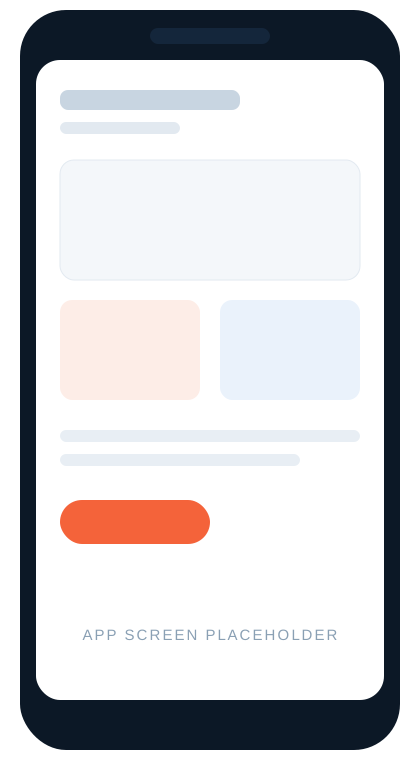
Placeholder: Android app screens mockup on a phone
Is this you?

Three reasons people come to us for an Android build.

1

Your users are mostly on Android.

Whether it's your market, your customer base, or simply where most downloads happen, the app needs to be right on Android specifically — not a cross-platform port that's almost right.

2

The app needs something only native can give it.

Deep hardware access, background precision, a widget, or a feature the platform itself has to provide directly, not through a workaround.

3

A cross-platform build let you down.

It felt slightly off, or hit a wall the framework couldn't get past. You want it done properly, once, in Kotlin.

What it costs

Starting prices, so you can plan.

Android MVP
$14,500
  • One core flow, done properly
  • Material Design 3 UI
  • Typically 10–16 weeks
Get a quote
Full product
$25,000–$60,000

Typically, once the MVP has proven itself.

  • More screens and integrations
  • Play Store listing optimised
  • Typically 16–28 weeks
Start scoping
Enterprise / multi-app
Quoted
  • Multiple apps or a large-team rollout
  • Security and compliance reviews
  • Dedicated team available
Book a scoping call
What's included

Set up to pass review, not just to launch.

Always included

  • A written scope and a fixed price before we start
  • UX/UI design to Material Design 3
  • Kotlin development, senior engineers only
  • QA across real devices — screen sizes, Android versions, low-end hardware
  • Play Store submission — data-safety form and listing prepared
  • Analytics and crash reporting
  • 30 days of post-launch support
  • Full ownership of the code and your Play Store account

Add when you need it

  • Maintenance and OS-update support from $490/mo
  • Backend and API development
  • Tablet and foldable-specific layouts
  • In-app purchases or subscriptions
Built native, properly

Kotlin and Jetpack Compose, Material Design 3 done properly.

Compose lets us build the interface declaratively and keep it consistent with the rest of the platform — animations, gestures and dark mode all behave the way an Android user already expects, without fighting the system to get there.

Kotlin, not a port.

Written for the platform from the start, not translated from somewhere else — so it behaves, and performs, like an Android app should.

Jetpack Compose UI.

Modern, declarative interface code that's faster to build on and easier to keep consistent as the app grows.

Material Design 3.

Dynamic colour, motion and components applied properly — not a generic UI kit with your logo on it.

The Android reality

One app, thousands of different devices.

Android runs on phones across a wide range of screen sizes, several OS versions still in active use, and hardware from last year's flagship to a budget handset with a fraction of the memory. We test for that reality, not just for the phone on our desks.

  • A spread of screen sizes and densities, not just one reference device
  • Back to the Android versions your users are actually still running
  • Low-end and budget hardware, where memory and performance actually get tested
  • Tablets and foldables, when your app needs to support them
Play Store compliance

Ready for review, not scrambling the week you submit.

Google's data-safety form, target API level requirements and permission justifications catch a lot of first-time submissions off guard. We prepare all of it alongside development, so submission day is a formality, not a scramble.

  • Data-safety form completed accurately, matching what the app actually collects
  • Target API level kept current to Google's requirements
  • Permissions requested only where they're genuinely used, with justifications ready
  • Store listing — screenshots, description and content rating — prepared before submission
Google ecosystem

The platform features that make an Android app feel native.

Google Maps

Location, directions and place search, built into the app rather than bounced out to a browser.

ML Kit

On-device text recognition, barcode scanning or image labelling — fast, and without sending data to a server.

Widgets

A home-screen widget that brings people back into the app without opening it.

How it works

From scope to the Play Store.

Weeks 1–2

Scope

A scoping call and workshop: the core flow, the devices that matter most, and what "done" means. You get a written scope and a fixed price.

Weeks 2–5

Design

UI screens in Material Design 3, reviewed as real, interactive screens before a line of Kotlin gets written.

Weeks 4–12

Build & test

Development in sprints, tested continuously across a real spread of devices, screen sizes and Android versions.

Weeks 12–16

Launch

Play Store submission, data-safety forms and listing handled, then we watch the first week of real installs.

Typical timeline: Android MVP 10–16 weeks; full product 16–28 weeks. What moves it: how many devices need explicit testing, and how quickly feedback comes back.

An honest note

Sometimes cross-platform is the better answer — and we'll say so.

If your app doesn't lean on anything Android-specific — no deep hardware access, no background precision, nothing platform-only — a Flutter or React Native build reaches both stores for roughly 30–40% less, from one codebase. We'll say that in the scoping call, before you pay for a native build you didn't need. See Cross-Platform Apps →

Get a free proposal for your Android app.

Send a few details and a senior Android engineer — not a salesperson — will come back within one business day with questions, a recommendation and a price.